
Commercial Roof Cover Boards vs. Insulation: What Is the Difference?
Roof insulation primarily limits heat transfer. A roof cover board typically sits above the insulation and directly beneath the membrane, providing a suitable surface for the roof covering and helping protect the layers below. Depending on the product and assembly, it can also contribute to impact resistance, fire performance, and wind-uplift resistance.
The distinction is about function, not just material. “Polyiso” names a type of foam; “cover board” describes a job within the roof assembly. A high-density polyiso cover board can provide both protection and some insulation value. It is not automatically interchangeable with conventional polyiso insulation or a gypsum-based cover board.
If you specify, price, or review roof assemblies, the useful question is not simply, “Which board is better?” It is, “What does this layer need to do, and is this product approved to do it in this assembly?”
In This Article
- Where Cover Boards and Insulation Fit in a Roof Assembly
- What Roof Insulation Does
- What a Roof Cover Board Adds
- How the Main Board Types Differ
- When You Need Both Functions
- What Affects Acceptance of a Board Substitution
- Information for Specifications and Submittals
Where Cover Boards and Insulation Fit in a Roof Assembly
A common low-slope roof arrangement, from bottom to top, is:
1. Structural roof deck.
2. Roof insulation.
3. Cover board.
4. Roofing membrane.
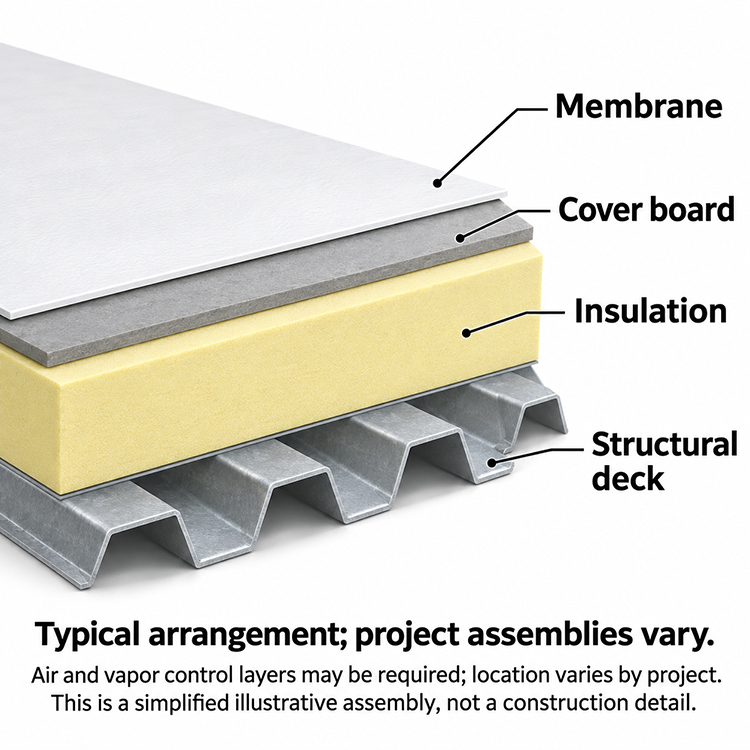
The deck provides structural support. Insulation addresses heat flow. The cover board forms the immediate substrate beneath the membrane, and the membrane provides the principal weatherproof covering. USG’s roof board application guide illustrates these separate roles.
This is a useful starting point, not a complete specification. A project may include an air or vapor control layer, multiple insulation layers, a board beneath the insulation, or a composite panel. Existing-roof conditions can introduce additional layers and requirements.
What Roof Insulation Does
Roof insulation slows heat transfer through the assembly. Its thermal resistance is expressed as R-value: higher resistance means less heat flow through that material under the stated conditions. Product thickness and the roof’s overall design both matter when evaluating thermal performance.
Conventional polyisocyanurate, or polyiso, insulation uses a rigid foam core with facers on its surfaces. Hunter’s H-Shield CG product information identifies a closed-cell polyiso core with coated glass facers. The facer is part of the product specification; “polyiso board” alone does not fully identify what is being proposed.
Our Hunter Panels insulation options include flat and tapered products. Flat boards contribute insulation thickness, while tapered insulation changes thickness across the roof to help establish drainage. Hunter’s Tapered H-Shield CG is one example.
Tapered insulation helps establish drainage by changing thickness across the roof. A cover board provides a protective surface beneath the membrane. The specified roof assembly determines whether both are needed.
What a Roof Cover Board Adds
A cover board gives the membrane a supporting surface above the insulation. It can also help protect insulation from damage associated with installation, service traffic, or impacts. Those benefits depend on the selected board and how the complete roof is assembled.
R-value measures resistance to heat flow. It does not indicate how well a board resists damage from workers walking on the roof. Compressive strength describes another property, but that value alone does not establish puncture or hail performance.
USG’s cover-board information identifies impact protection, fire performance, and wind-uplift performance as reasons for using these products. The performance ratings apply to documented roof assemblies, rather than to every roof containing a cover board.
When workers walk on the roof to install or service rooftop equipment, the membrane still needs appropriate protection. A cover board beneath it does not replace that protection. Before adding a new board, wet insulation, a deteriorated deck, or an unsuitable substrate must also be addressed.
How the Main Board Types Differ
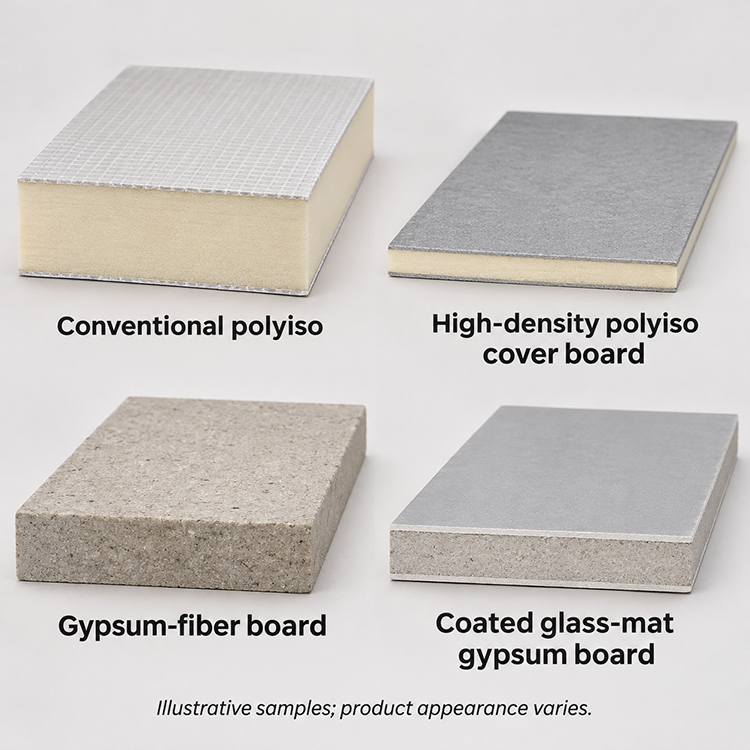
A board’s intended role, material, and approved applications determine where it fits in the roof assembly. The comparison below outlines the main differences.
| Board type | Main role in this discussion | Selection factors |
| Conventional polyiso insulation | Provide thermal resistance | R-value, thickness, facer, compressive properties, and compatibility with the specified system |
| High-density polyiso cover board | Provide a protective membrane substrate while contributing R-value | Approved application, facer, attachment, impact performance, and documented thermal contribution |
| Gypsum-fiber cover board | Provide a dense substrate beneath the membrane | Membrane and adhesive compatibility, thickness, weight, attachment, and assembly approvals |
| Glass-mat gypsum cover board | Provide a gypsum-based substrate with a glass-mat surface | Exact coated or uncoated product, intended attachment method, surface requirements, and assembly approvals |
Product suitability depends on the board’s position in the assembly, the membrane above it, and the attachment method. We help compare board options with manufacturer requirements and obtain technical information for the proposed assembly.
Gypsum-fiber and glass-mat products need separate review
Our USG roof-board offering includes products relevant to these decisions. USG describes Securock Gypsum-Fiber Roof Board as a gypsum-and-cellulose-fiber product for fully adhered and mechanically attached systems.
Glass-mat products require attention to the full name. USG’s roofing product comparison guide distinguishes UltraLight Glass-Mat Roof Board for mechanically attached systems from UltraLight Coated Glass-Mat Roof Board for cold-applied fully adhered systems. Its coated glass-mat product page specifically describes the surface for adhered applications.
A proposal shortened to “gypsum cover board” can leave the bonding surface and intended application unclear. The full product name and the membrane manufacturer’s requirements establish which board is suitable for the proposed system.
High-density polyiso is still polyiso
Versico’s SecurShield HD Plus product information provides a useful example of a polyiso product intended as a cover board. Its technical data bulletin lists an R-value of 2.5 for the half-inch board and identifies its intended use in fully adhered systems.
The published R-value contributes to the assembly’s thermal resistance. The main insulation layer still needs to provide the thermal resistance required by the design; the high-density board provides the protective surface beneath the membrane.
Composite boards can combine functions
Hunter’s H-Shield HD Composite CG combines a high-density polyiso cover board with conventional polyiso insulation in one manufactured panel. One panel can therefore provide both insulation and a protective surface beneath the membrane.
A composite panel provides both functions in one product. Its membrane-facing surface, attachment method, and acceptance in the specified roof system still need to suit the proposed assembly.
When You Need Both Functions
A roof can need substantial thermal resistance and a suitable protective substrate beneath its membrane. Separate insulation and cover-board layers are one way to provide those functions; an accepted composite product may be another.
Whether a cover board is required, recommended, or optional must be determined for the proposed assembly. The membrane system, attachment method, project performance requirements, rooftop use, and warranty conditions all influence that answer.
Versico’s VersiFlex PVC warranty submittal sheet, for example, identifies components for specified warranty configurations, including cover boards and attachment requirements. Those system-specific conditions help determine which board and attachment options qualify for the proposed warranty.
A cover board may be optional in one manufacturer configuration and required in another. Project specifications can also require one even where a manufacturer permits an assembly without it.
What Affects Acceptance of a Board Substitution
Imagine a fully adhered roof specified with conventional polyiso insulation and a particular coated glass-mat cover board. A proposed alternate offers the same total R-value but uses a different board at the membrane surface.
Matching the specified R-value addresses thermal resistance. The proposed board still needs to meet the roof system’s substrate, attachment, and performance requirements.
Evaluation starts with the differences between the specified board and the proposed alternate: material, facer, thickness, and attachment. Those changes can affect adhesive compatibility, membrane support, and the assembly’s documented fire, uplift, or hail performance. A matching total R-value addresses thermal resistance but does not answer those other performance questions.
Warranty eligibility and the project’s substitution procedure also affect acceptance. We help obtain manufacturer documentation and clarify product compatibility for the proposed alternate. The project’s designated reviewer determines whether the substitution meets the design and specification requirements.
Higher compressive strength describes one property of the board. Bonding surface, weight, thermal contribution, and acceptance within the specified roof system also affect whether it can replace the specified layer.
Information for Specifications and Submittals
Clear roof specification writing helps identify each board layer before proposals arrive. Specifications and submittals should make the following information clear:
1. Required function: Insulation, membrane support, protection, slope, or a documented barrier function.
2. Exact product: Manufacturer, product name, material, facer, thickness, and relevant properties.
3. Adjoining materials: The membrane, adhesive, insulation, or other layer touching the board, with documentation of compatibility.
4. Assembly requirements: Applicable manufacturer requirements, tested or listed construction, and project performance criteria.
5. Substitution documentation: Evidence addressing the affected functions and approvals, rather than a matching thickness or R-value alone.
This information gives the design team, contractor, and owner a shared basis for comparing proposals. The board manufacturer provides product properties, the membrane manufacturer identifies accepted applications, and the responsible designer evaluates the proposed assembly. RoofSource helps bring the relevant manufacturer information into those product-selection and specification discussions.
Discuss Roof Assembly Components With RoofSource
We represent insulation and roof-board manufacturers and assist architects, specifiers, contractors, and building stakeholders with product comparisons, specification questions, and manufacturer coordination. Our work helps connect the selected components with the intended roof-system requirements.
Bring us your proposed assembly, board options, and project requirements so we can help compare the products and obtain manufacturer answers about compatibility and intended use.
Frequently Asked Questions
No. A cover board sits beneath the membrane. It does not remove the need for the roof system’s prescribed walkway protection or precautions during equipment servicing.
A cover board is not a remedy for wet insulation. The existing roof must be evaluated, and affected materials addressed according to the project requirements before the new assembly proceeds.
No. Products still need to be approved together for the proposed membrane, attachment, substrate, and project conditions. A shared manufacturer name does not make every combination acceptable.